
Sketches from Mackinac
We went up to the Mackinac/Mackinaw area this weekend.
I’ve been wanting to get away for a weekend; to sleep in, see the water, find a diner for some greasy breakfast and explore nature with the pup (And of course, to paint a bit…) so we decided to make the 4 hour drive northward.

I had just gotten a new sketchbook that I was really excited to try out. It’s an accordion fold from Hahnemule with really heavy watercolor paper. It felt a bit like a AAA map from road trips of yesteryear, so I decided to make some contour drawings of the land and use the colors of our drive to be a ‘map’ in another sense.
I also brought along these water-soluble ink blocks from Derwent that I tried out a few weeks ago.


It was a beautiful drive up. Seriously, Michigan is a gorgeous state.
We got in a bit later than planned, so we let the pup walk around and headed straight to dinner. I was hoping to make a few beach-side color studies but had lost all my light. Sketching would have to wait until tomorrow.

Mackinaw City Sunrise.
The next morning I was greeted with a spectacular sunrise and whatever irritation I felt for missing a chance to sketch by the water last night, was totally gone.
Once the sky had lightened enough I gathered my ink blocks, drawing board and a fresh rolled canvas from Fredrix and set up on the chilly, windy beach.

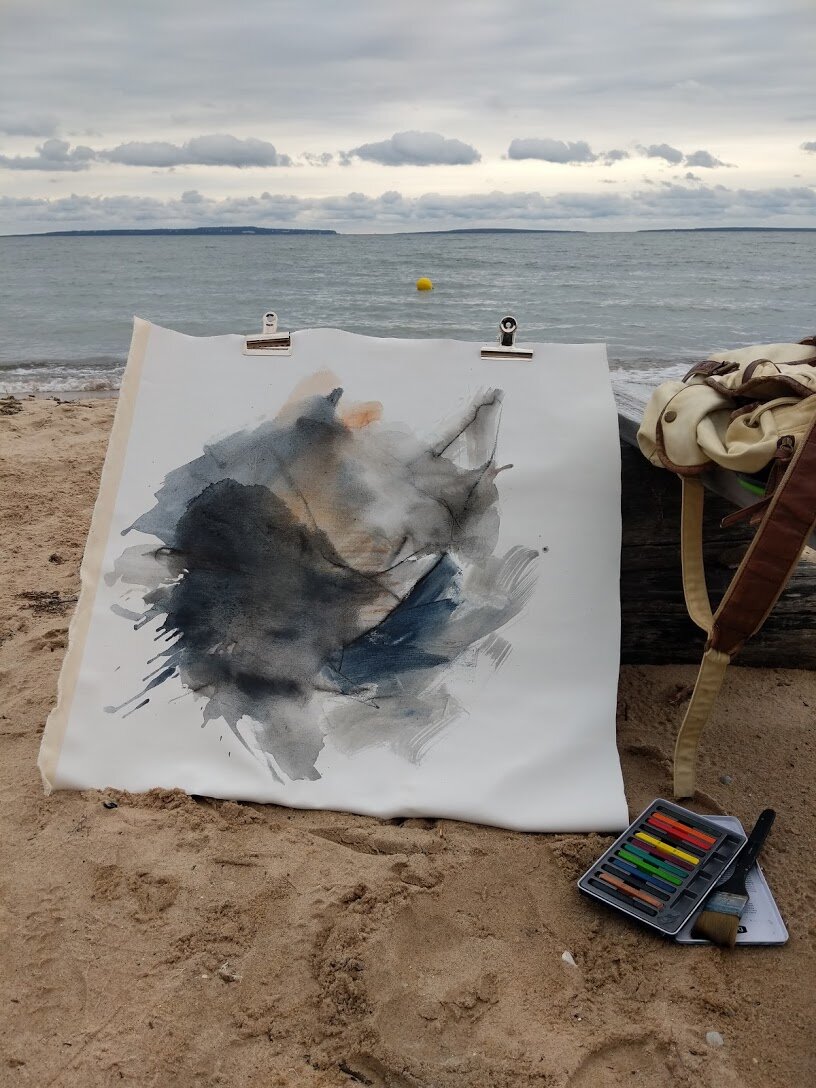
I didn’t exactly dress for the weather, so this was a quick painting session. The Inktense blocks worked beautifully on the canvas (pre-gessoed) allowing me to get the color and motion down in quick strokes.
A new thing I just discovered with the pup; usually I bring back my work to dry on the hotel floor. I can’t do that anymore unless I want to add little paw prints to the design ( paint is definitely not something that should be on dog feet…) so I had to get creative about where to store the wet canvas overnight.

Luckily, there was a perfect sized luggage rack in the cabin’s closet.
We’ll head home in a few days, hoping to get a few more chances to paint along the water - the colors up here are just so incredible.
Hope you’re all having a wonderful weekend!
Studio Organization and Storage for Small Spaces
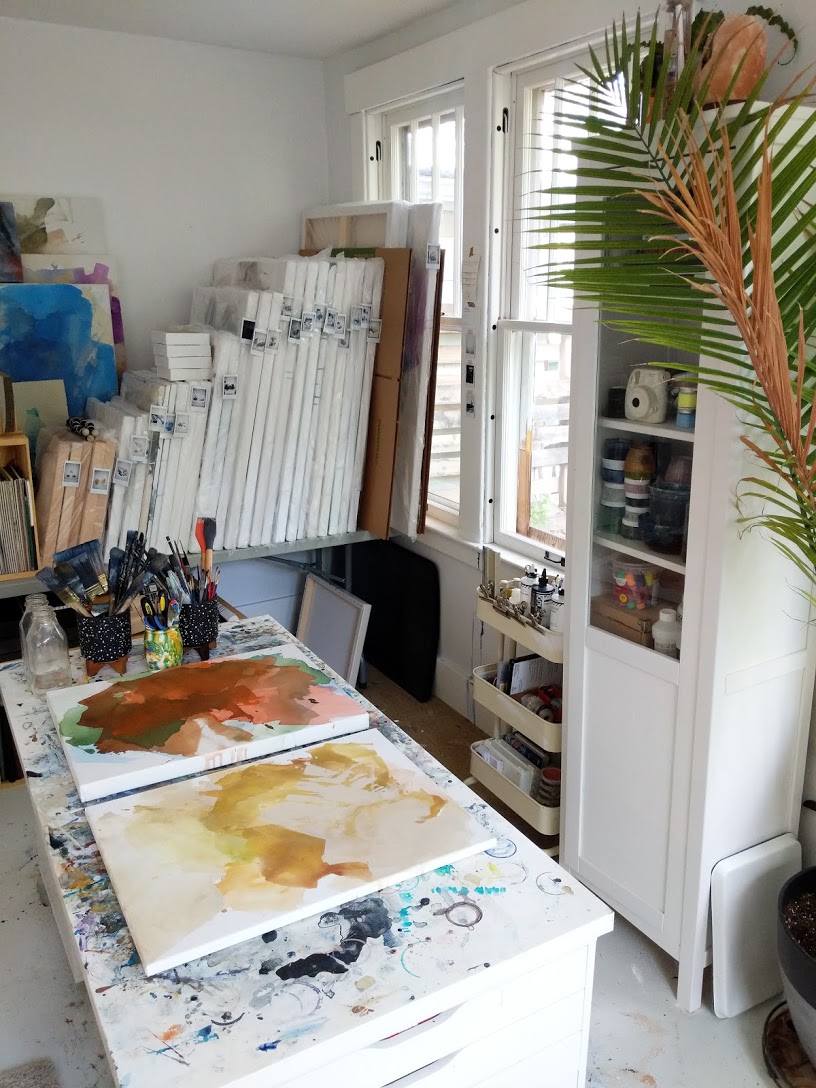
Finished!
With giving up my off-site studio earlier in the summer and a planned art space in the basement being shelved due to larger issues with the basement (one of the many exciting things about living in a 130 year old house….) the space for my art is a bit limited currently.
Previous to getting our puppy my work would simply spill out into the living room, or I would paint on the floor of the dining room if pressed for space — no big deal. Now that he is in our lives that’s both unsafe for him AND the paintings. I need everything to fit in the confines of my actual studio room and for the doors to close.
I always prefer to look at obstacles as challenges, and as someone who began working at a tiny desk, then graduating to the kitchen table - I can work with a small space. I just need to get smart about where things are located and build upwards.
After a few iterations on paper I purchased a couple of items on Amazon and started laying out my plans.
(Also a note, some of these are affiliate links - no extra charge to you if you purchase through me, but I receive a small portion of the proceeds.)

Taking pictures first!
Step One; Photographing work (for storage and display)
I start by grouping the paintings into those that still need to be photographed, and those that don’t. For photos I try to make sure I have 3 types:
A few photos on my phone. (These are for instagram and other quick sharing apps.)
A few hi res photos taken with my DSLR. ( I use these for my website and marketing materials)
One Instax photo (I take these and stick them onto the wrapped canvases. This way I know exactly where each painting is without having to dig through the stacks.)

Any excuse to use little guy. I love him.
Step Two; Protecting the Finished Paintings
I like to keep my paintings wrapped in clear plastic with reusable enclosures. This keeps out the moisture, flying paint, bugs and whatnot. (Example: Canvas Bags from Clear Bags)
Once they are wrapped up I add the instax photos to the longest side.
I’ll be stacking these upright on top of a heavy duty table, so considering where the canvas will touch other canvas is extremely important. Canvas leaning directly into canvas is a good way to dent work, so I always stack bar-to-bar or face-to-face. When sizing differs, I use sheets of cardboard to spread out the force.

See the cardboard?
To store work like small canvases, boards or paper I use these bamboo dish drying racks. It’s important to make sure the work isn’t resting on the spindles however, so if the painting is of a size that could shift and collapse inwards I don’t use these. Great for work 11 x 14 and under!

Bad! Don’t let your canvases get dented!

This is much better.
Another thing I keep by my work is a little thermometer/humidity monitor. (This is how I learned the basement wouldn’t be a suitable storage area until we handle a few other issues.) Humidity and my artwork do not mix. I’m sure in most homes and studios it’s not necessary - but we’re still learning all the fun aspects of this place so I like to have a record of the temperature and moisture content of the air.

Now that the storage area is all set - it’s time to work on the supplies!
I’m terrible at letting supplies sit out and build up and completely take over my painting surface. In my previous studio layout (painting table against the wall) the miasma of water cups and mixed paints would grow each day out from the walls like some fantastically colored mold…. which is exactly how I ended up painting in the living room.
So I Marie Kondo-ed everything in my painting cart, on my painting table and in my cabinet and ended up with a much smaller collection of materials I use daily.
( I did deviate slightly from the traditional Marie Kondo method, as I didn’t get rid of the lesser-used supplies, I just moved those into storage in the basement. I still use them, but not often enough to take up valuable studio space)

Yikes.
The Cart:
It was a disaster before, no rhyme or reason for where things were stored. When we brought home little Chewbacca I removed everything chewable from the bottom shelf and just sort of haphazardly put it on top until I could find somewhere else to keep it. It stayed there for way too long.
My new method; all heavily used paints go on the top shelf (out of reach of prying mouths), all lesser used paints go in the cabinet. The second shelf is for tape and boxes of pencils/markers/pastels, the third shelf is all of my palettes.
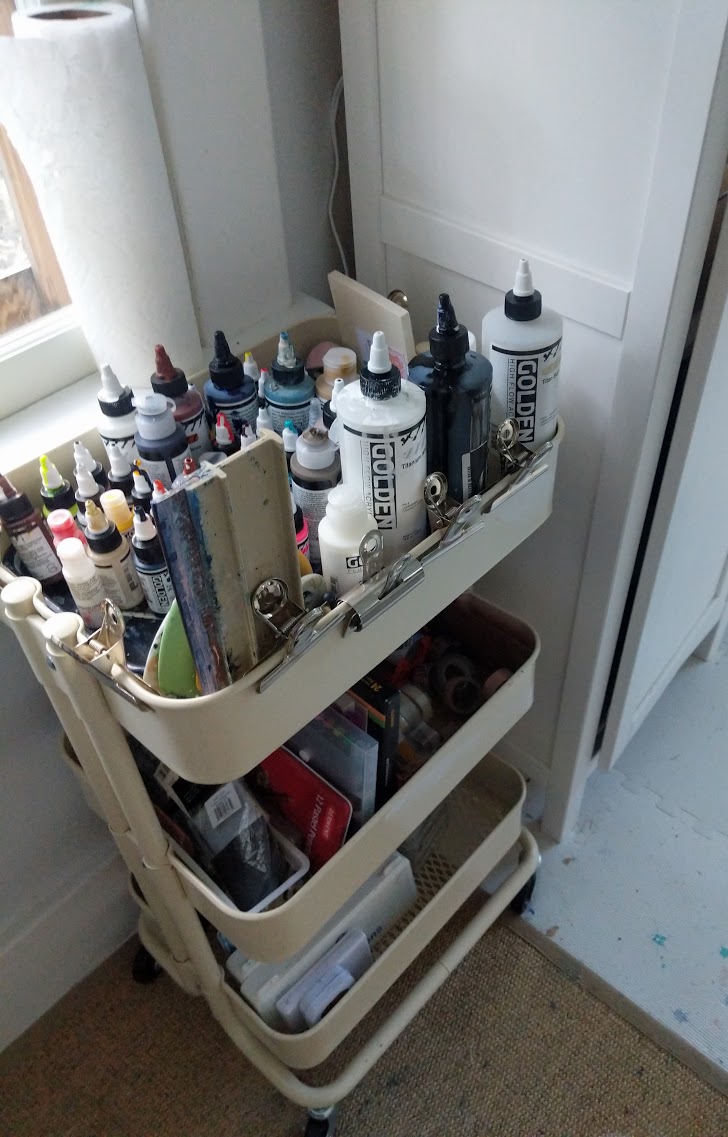
Everything is much more easily accessible - and puppy friendly.
I want an empty table. Well, empty-ish. Brushes, basic tools, pencils - everything I use in day-to-day can be out, but that’s it. When I had my off-site studio space I ADORED being able to walk fully around the painting area, so I wanted to keep that a function of this space.
I ditched the metal legs under the table and instead set it on top of my two flat files. By combining the furniture in the space I could open up a bit more walking room. This setup also discourages any significant cup/paint buildup as there are no walls so grow outward from. Fingers crossed it can stay this way!

So this is where my space is at currently. Even though more paintings are being stored in here I think I ended up giving myself a larger workable area, which is exciting. The early fall light is so perfect in here too, the pup can take advantage of more sunbeams!
I may look for additional storage/studio space next summer, but for now I’m really happy with my tiny studio.

Obligatory puppy tax <3
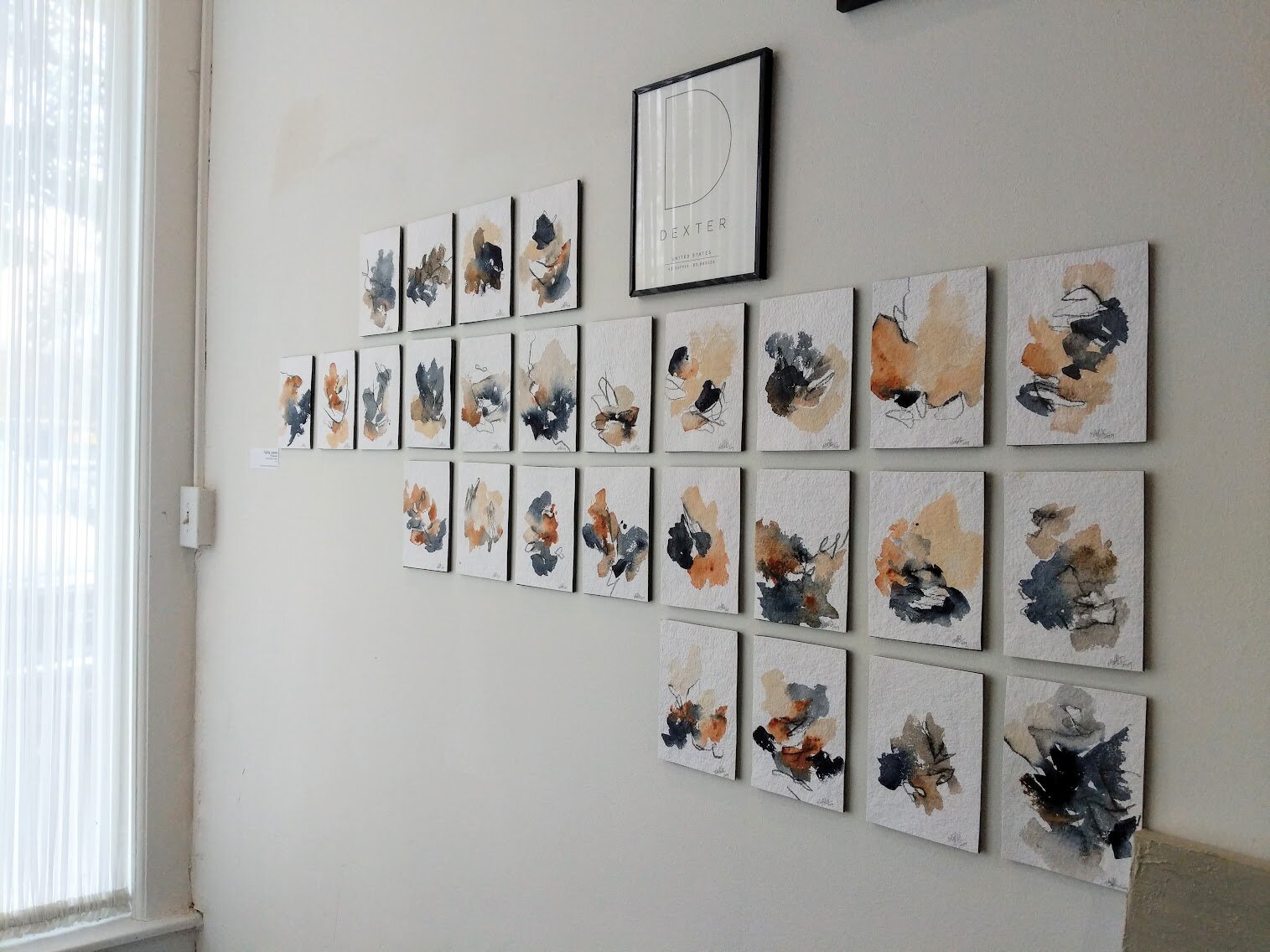
Falling Leaves at Park Ave Studio
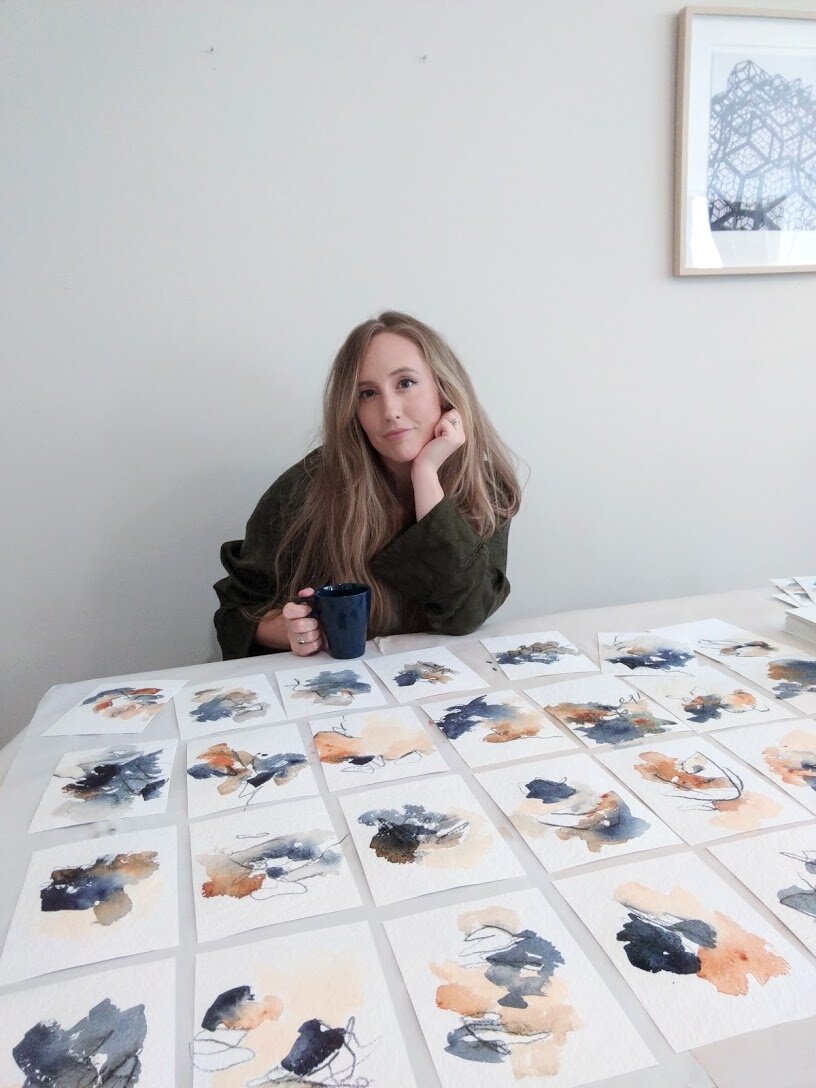
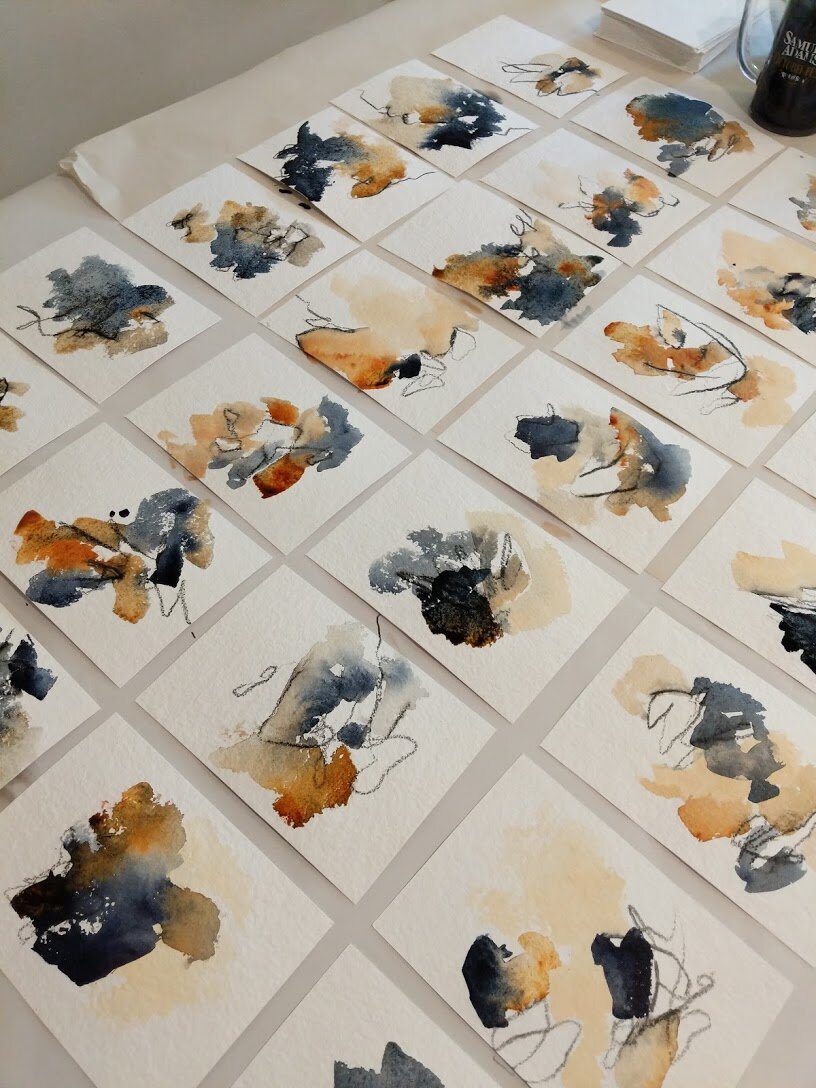
The Falling Leaves series was started on accident.
Since adopting our puppy back in June my time has been a bit jumbled, with the majority of it being spent training and playing - then going to commissions and my own explorations in paint last.
(Which was the plan -- I've waited my entire adult life to finally have a pup friend so I prepared to take time off.)
But I did need to keep making.
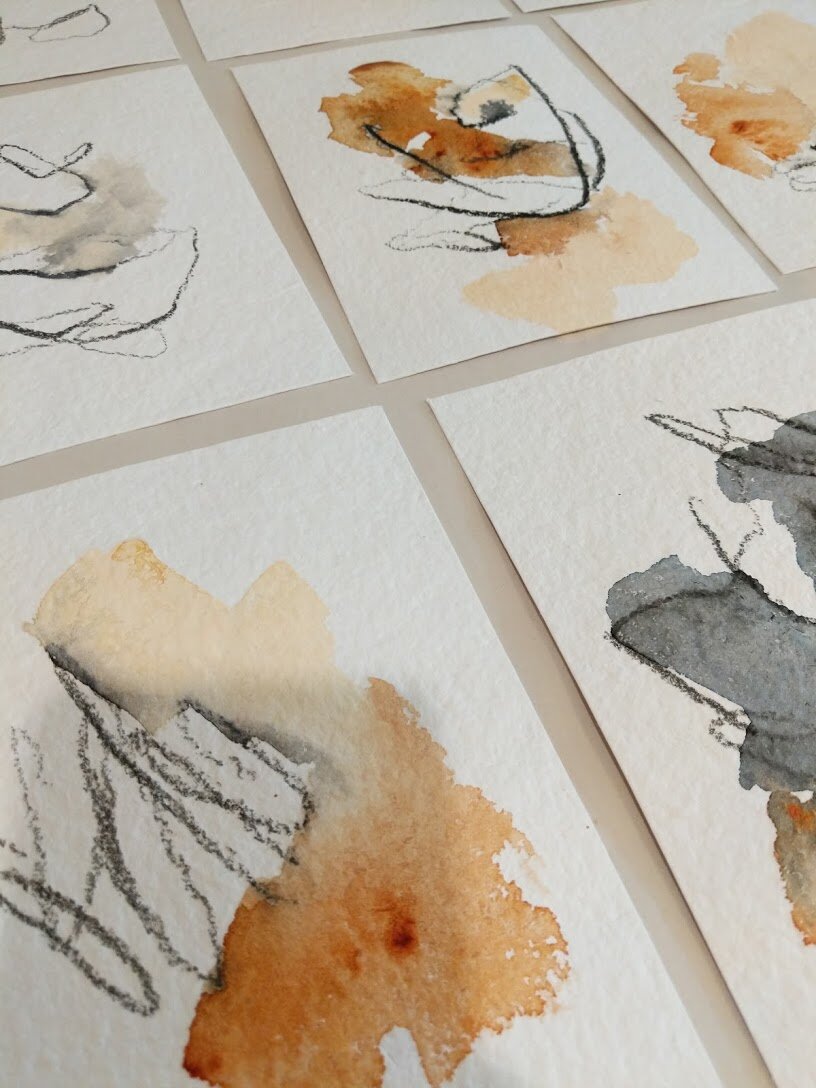
A few weeks back I started making contour sketches during our multiple daily walks of falling/fallen leaves. I’d follow their movement as they spun in the air to the ground, draw the lines of their shapes as they curled in on themselves; nothing very in-depth, just a quick scribble in my sketchbook and we would move on.
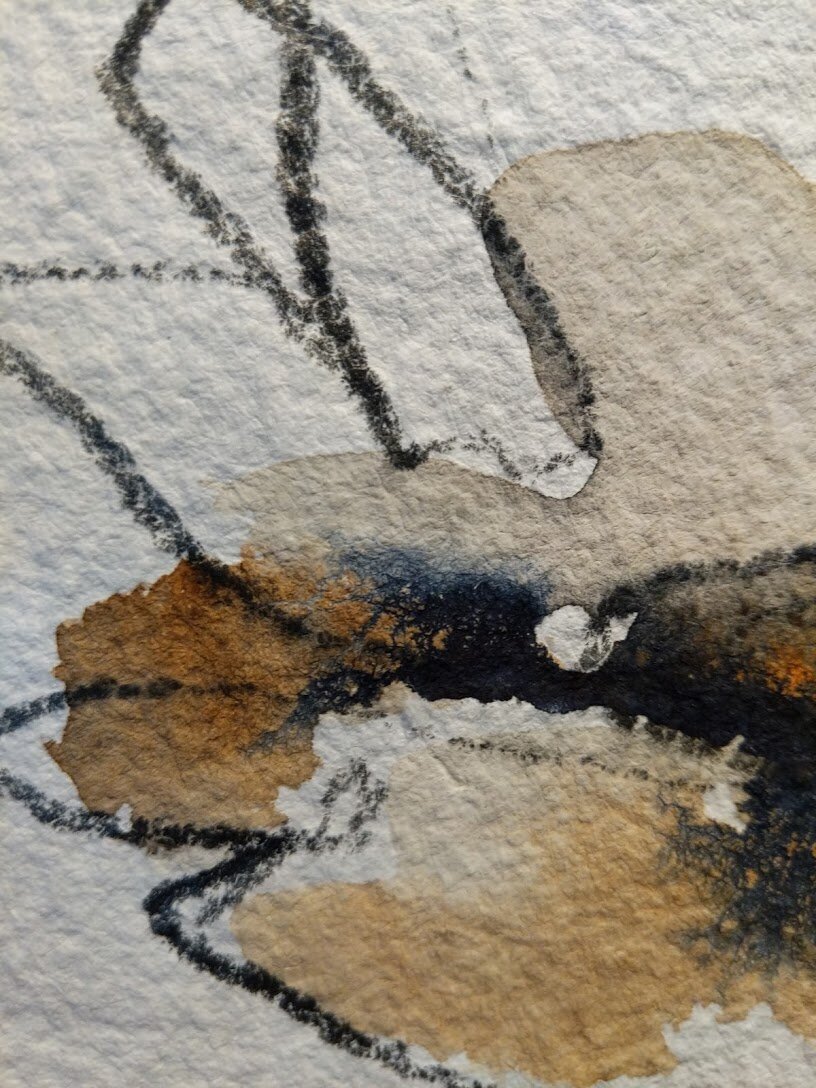
After enough piled up I decided to take some of my favorites and transfer to paper, then added a few layers of color keeping to the original movement of the sketch.
And the series became a thing.
It was installed at Park Ave Studio on Main Street in Dexter.
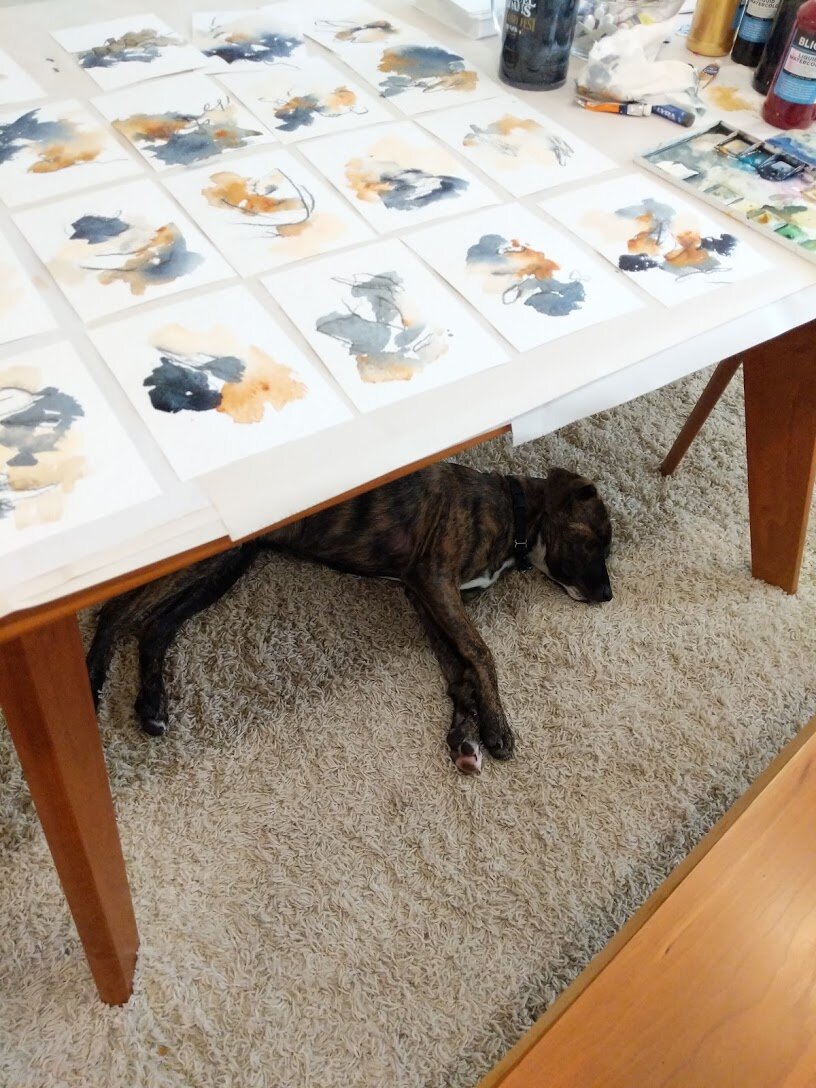
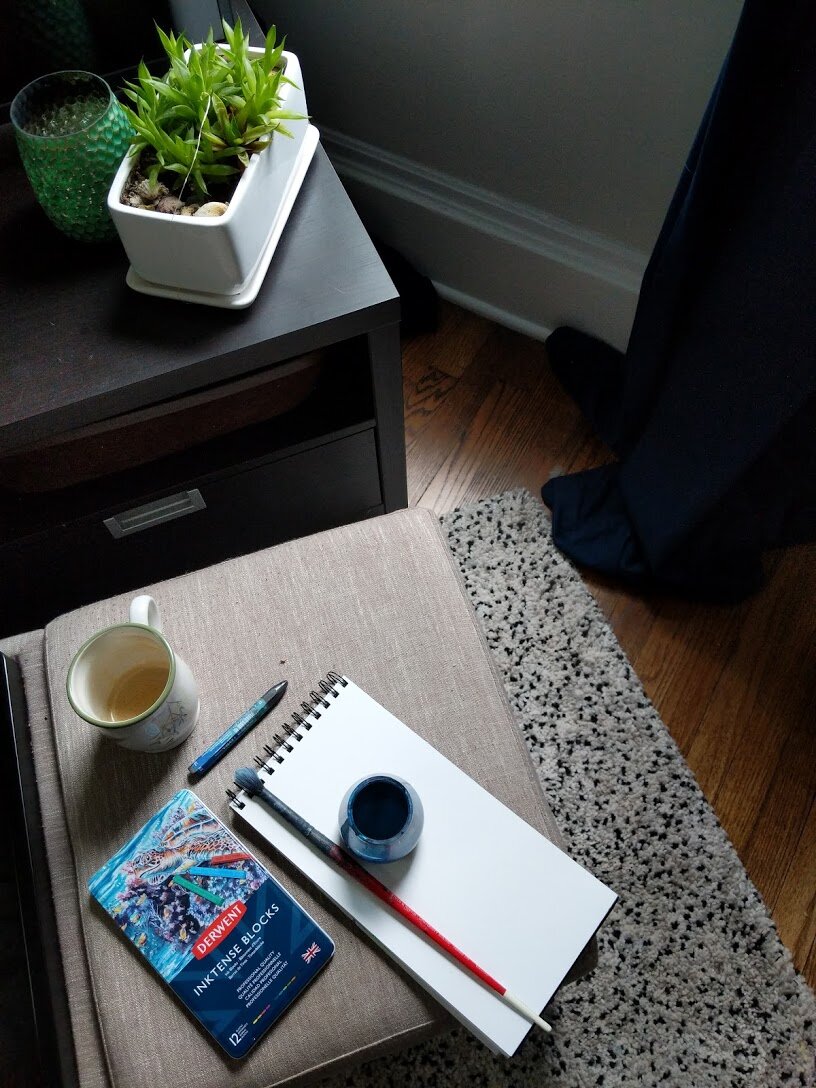
Trying out the Derwent Inktense Blocks
(Not sponsored, just excited to try out new materials. This post does contain affiliate links, if you’re interested in trying out these blocks consider purchasing through the link. No extra cost to you, but Amazon sends me a few bucks!)
I’m hoping to plan a weekend getaway soon - we’ve all been cooped up in here for most of the summer and I am ready for a little adventure.
Of course, as with every adventure my supplies come along for the ride - but if we’re gone for just a few days I don’t think I want to bring EVERYTHING I usually do. I might just concentrate on making a few small sketches while away instead.
To this end I picked up these water-soluble ink blocks from Derwent and I’m excited to try them out. They are certainly packable, and if they are versatile enough I might bring these and no other paints.
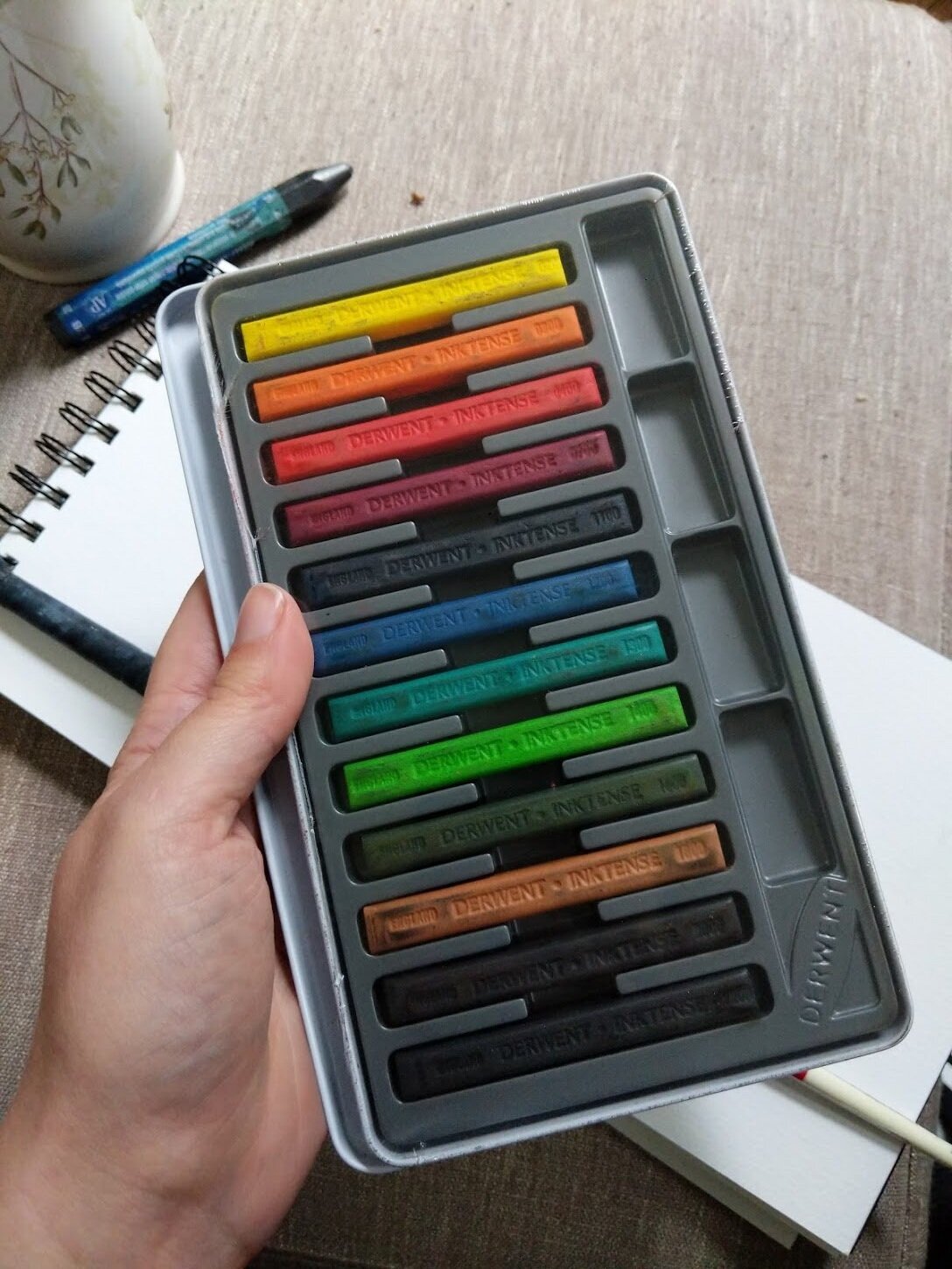

Dry block, with a bit water
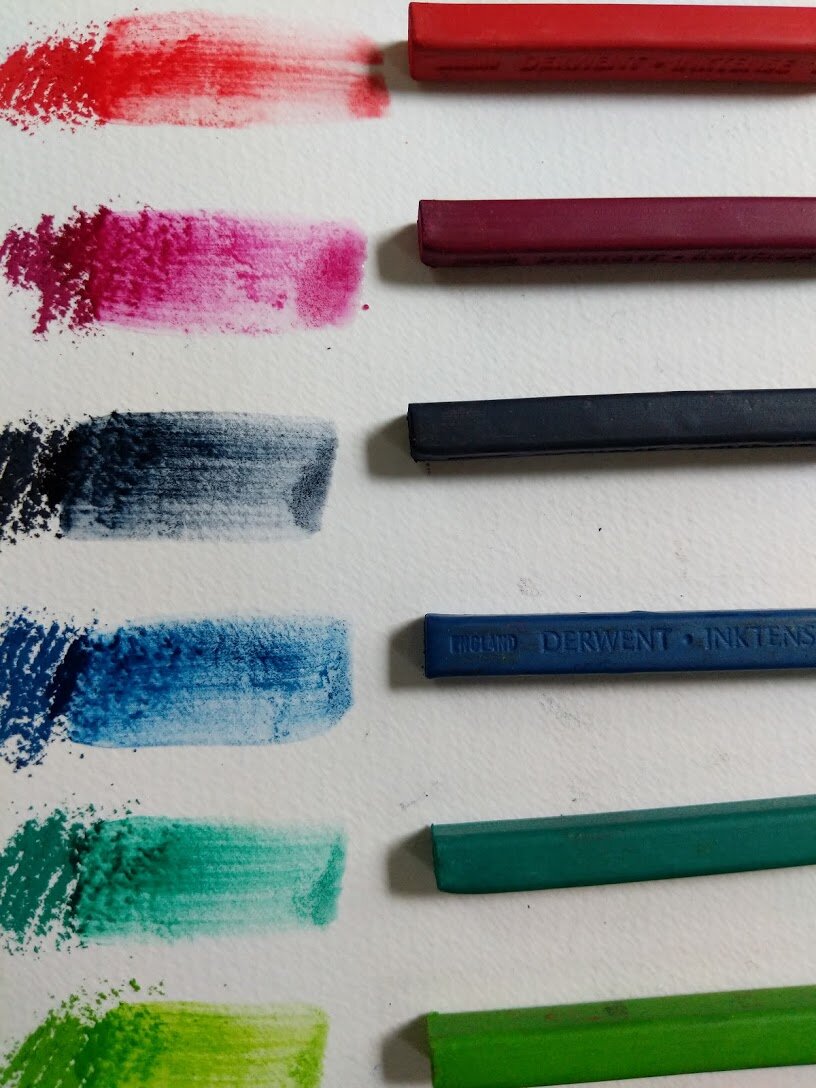
The block are really vibrant dry AND wet.
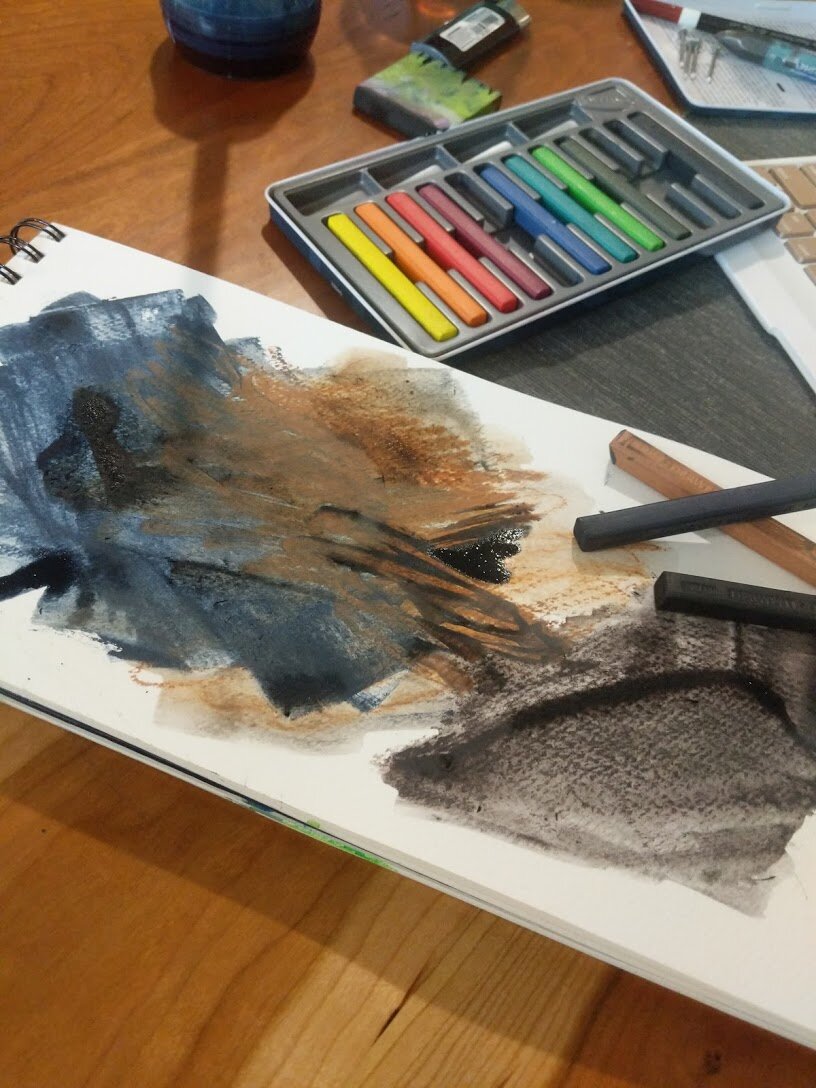
Testing the layers/translucency
I’m really happy with hows these performed.
Really beautiful pigment when dry, and with water it’s easily blendable and layerable. Perfect for my purposes and exactly what I was looking for in a small set of travel paint/pigment.
We may not have the destination picked out yet, but at least I know what supplies I’m bringing along.
<3 <3
Paint tests on Fredrix Canvas METALLICS!
Whenever I try out a new surface I always dedicate one to absolute experimentation.
I use as many paints as I can in an attempt to learn the surface and see how it reacts to my materials. It’s always messy and usually not great looking at the end, but always fun.
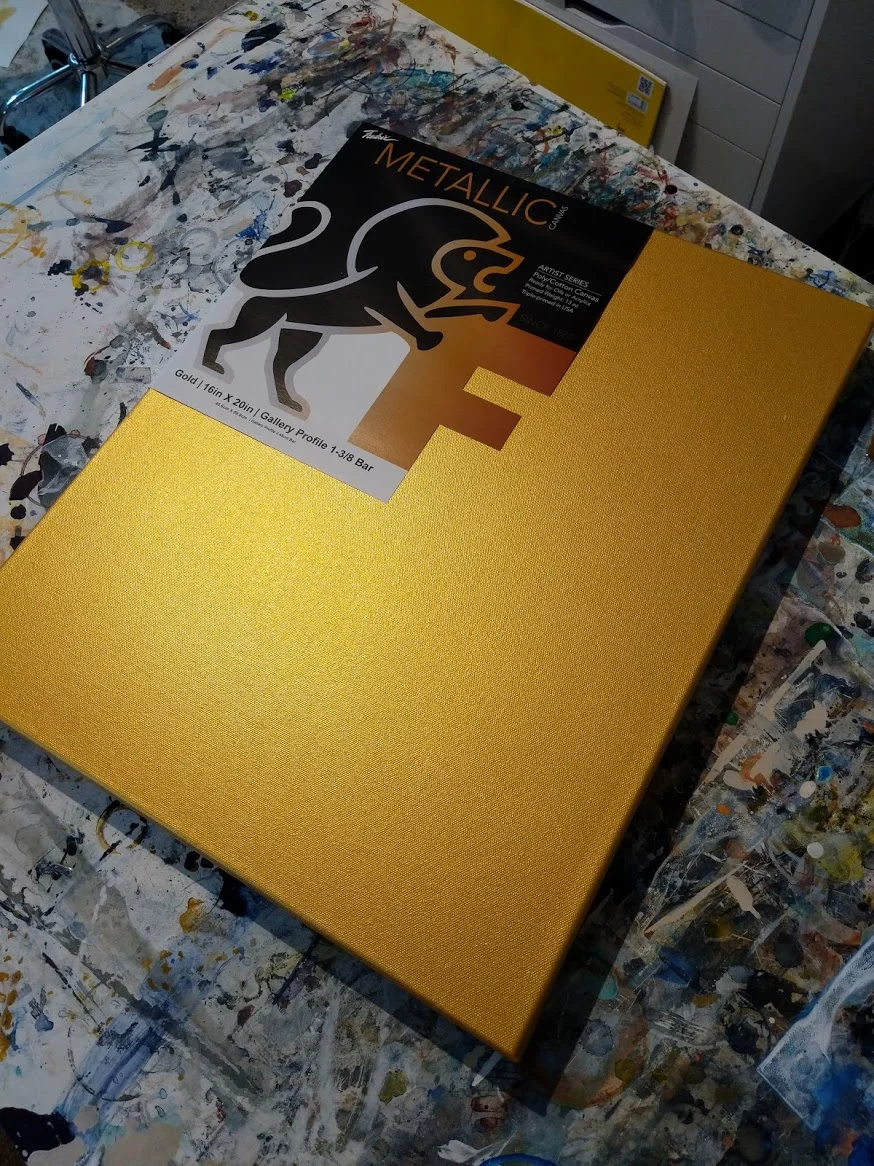
Look at that SHINE.
This is the metallic gold canvas, from Fredrix Canvas. It’s a 13 oz poly/cotton canvas that has been triple primed with a universal metallic gesso (either in gold or pearl) and it’s GORGEOUS to behold.
I haven’t used too many pre-painted canvases before, so I definitely wanted to make sure and do an experimentation round first.
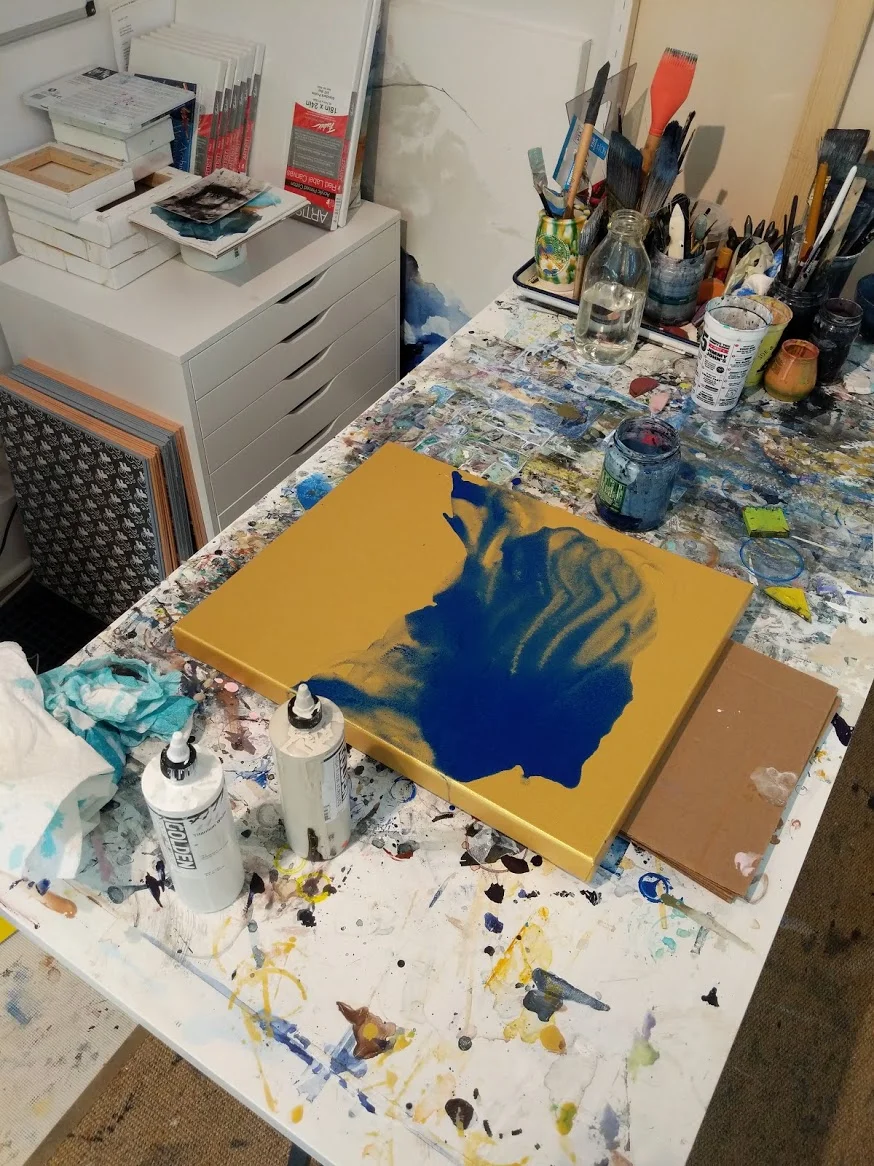
Layer 1: Thinned acrylic
I didn’t have a plan when I started (the key is experimentation) so I just started mixing and putting down various layers. This first one is a heavily thinned acrylic (water + glazing medium) to see how the gold comes through a very light wash of pigment.
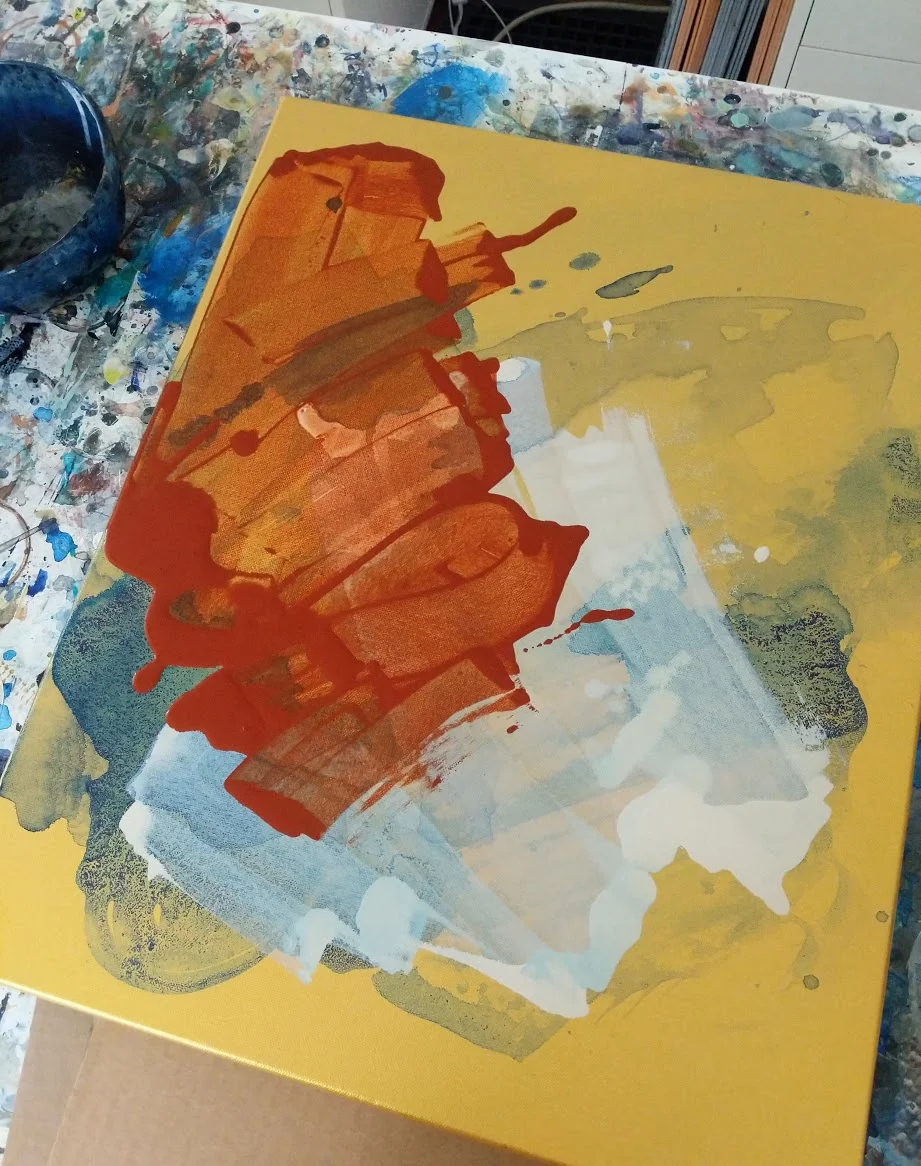
Layers 2 and 3; Golden Hi-Flow (unthinned)
After letting the blue dry I added two layers of Golden hi-flow paint without diluting either color. I’m loving how the sheen of the canvas comes through these first three layers.
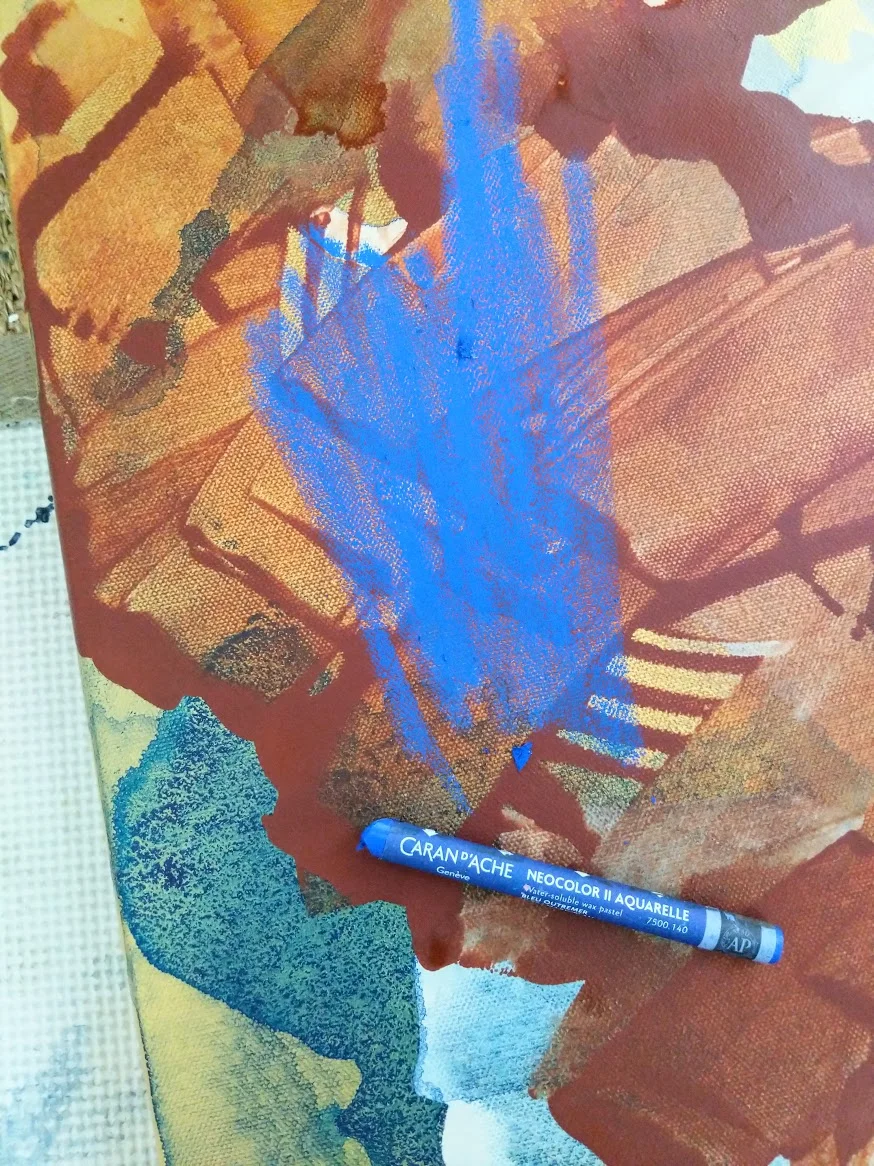
Layer 4: Watersoluble pastel
Next up is a bit of water-soluble pastel. I added it with a relatively heavy hand as I wanted as much pigment as the crayon could muster.
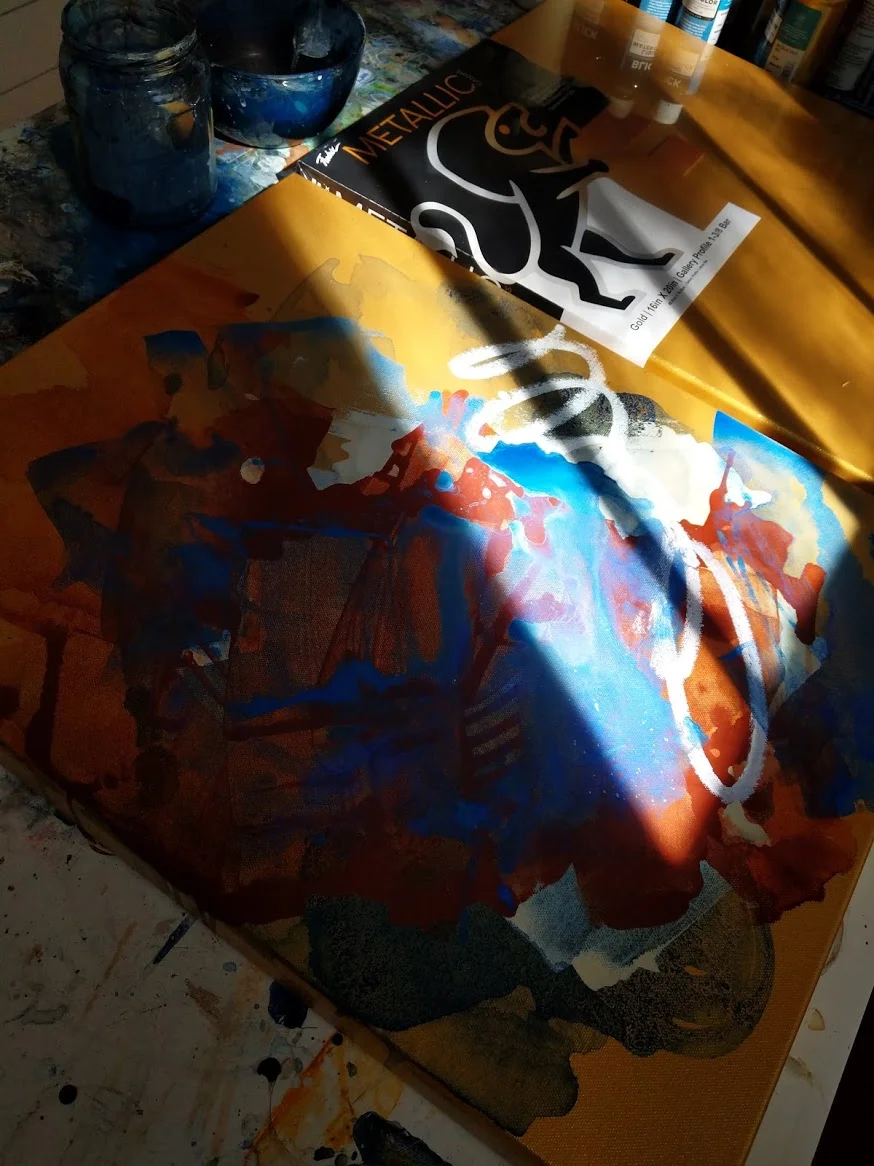
Layer 5: tempera stick
After the water-soluble pastel dried, I wasn’t too excited with it. Just a bit too thick and really seemed to cancel out the metallic sheen. I made a note to stick to thinner paints going forward - I love the metallic hints through the layers so I definitely want to preserve those.
I added a few circles of tempera stick next (bottom right of the canvas) and was pleased with how smoothly they applied to the surface. Again though, just a bit too opaque - so I probably won’t use these heavily on a real painting, but good for small details and line work.
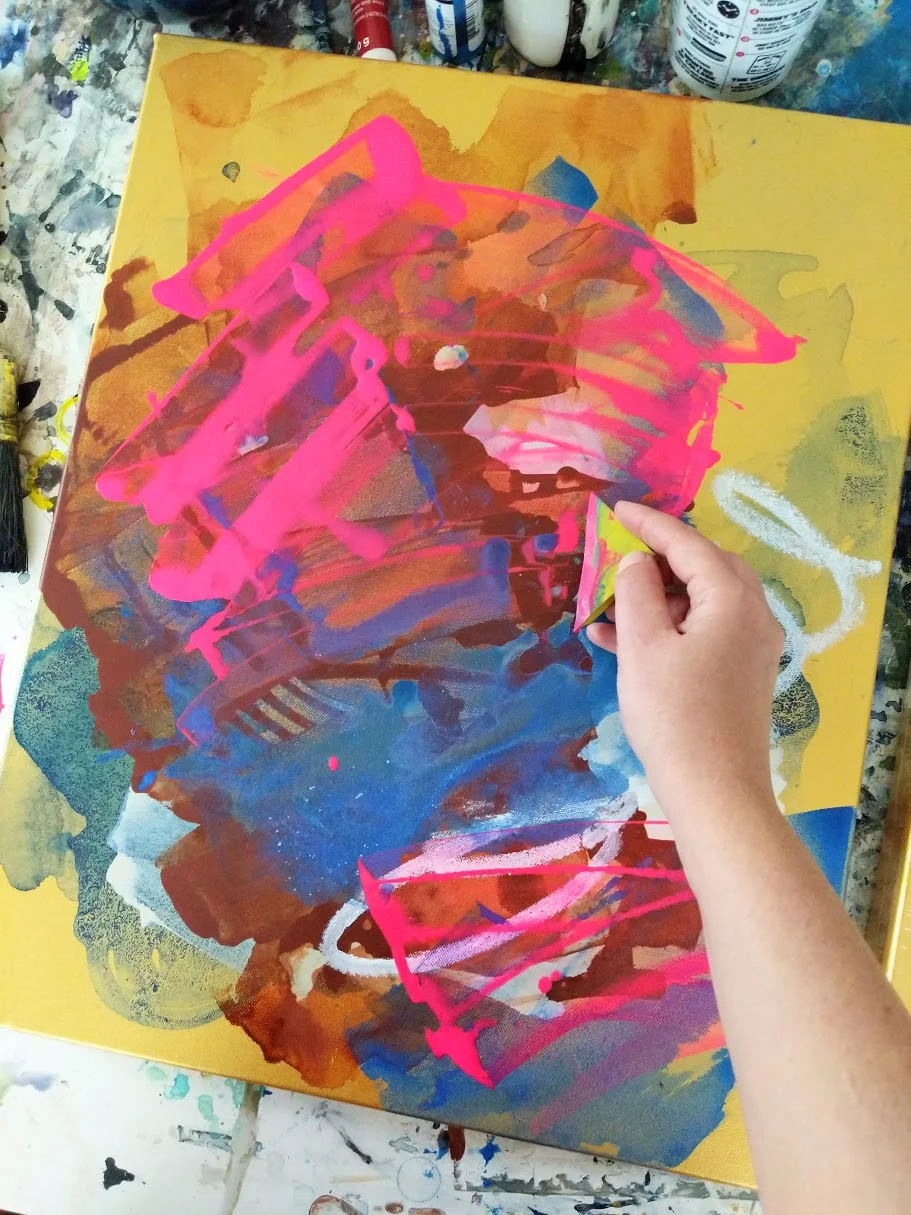
Layer 6: slightly thinned florescent!
And finally I added a last layer of ever-so-slightly thinned florescent pink acrylic. I was curious how the bright color would interact with the metallic under the layers, and it’s definitely something I want to pursue further.
I’ve got a few ideas for sketches that I think would translate well to the gold surface, so I’m excited to move on to a little more serious work on these.
Have you tried a metallic canvas before? I’d love to see what you painted on these!